Facebook Ad Copywriting: How to Write Ads That Get Attention and Clicks
Facebook ad copywriting is one of the most profitable digital skills any tech marketer or business owner can master today. Every single second, millions of users scroll rapidly through their Meta feeds, ignoring almost every promotional banner they see. Therefore, learning how to pair your visual creative with persuasive text is the only way to stop the scroll and earn the click.
However, many brands spend thousands of dollars testing ad graphics while treating their written message as a complete afterthought. Consequently, their click-through rates plummet, and their customer acquisition costs skyrocket. In this comprehensive guide, you will learn the exact step-by-step system for Facebook ad copywriting that turns cold scrollers into paying customers.
Furthermore, we will break down the anatomy of a high-performing Meta ad, proven psychological formulas, and common pitfalls to avoid. As a result, you will walk away with a practical framework to write ads that consistently deliver a strong return on investment.
What Is Facebook Ad Copywriting and Why Does It Matter?
At its core, Facebook ad copywriting is the strategic process of writing persuasive text specifically for paid placements across Meta platforms. Unlike search engine ads where users actively look for a solution, social media users are simply browsing for entertainment or connection. Therefore, your ad text must gently interrupt their browsing session and immediately spark their curiosity.
Specifically, great visuals may capture a user’s initial glance, but the words convince them to actually click your link. For instance, a sleek software mockup looks nice, yet it cannot explain how your tool saves a project manager ten hours a week. Consequently, effective Facebook ad copywriting bridges the gap between a passive view and an active conversion.
Moreover, Meta’s ad delivery algorithm heavily rewards advertisements that generate high engagement and strong click-through rates. When people stop to read your primary text and click your call to action, the platform views your ad as highly relevant. Ultimately, better ad relevance leads to lower costs per click and much higher profitability for your tech business.
The Anatomy of High-Converting Facebook Ad Copy
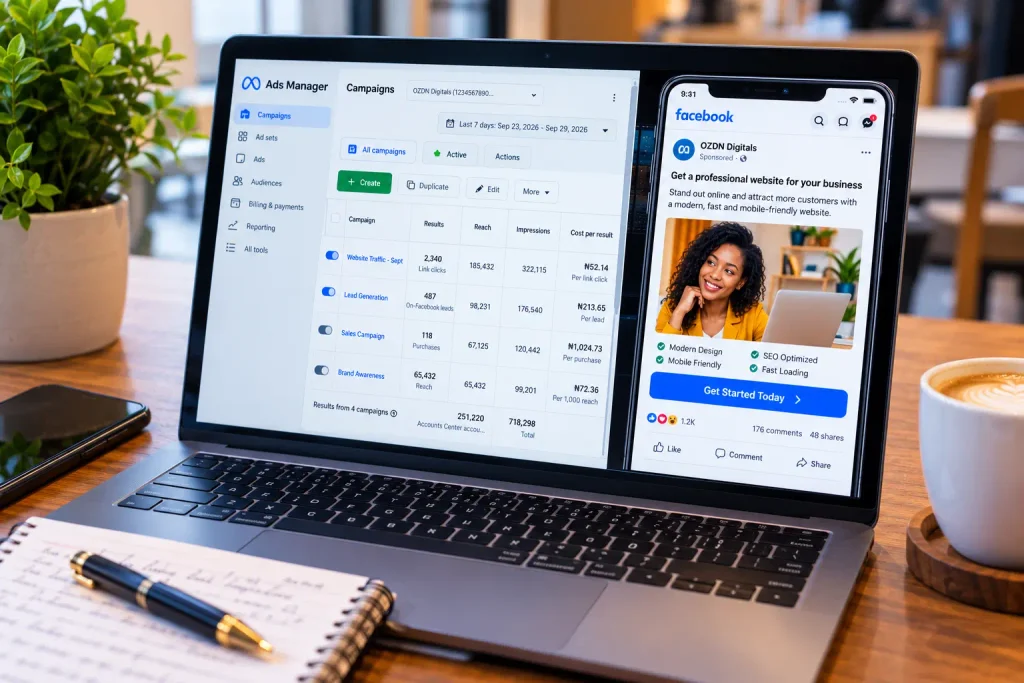
Before you write a single word, you must understand the four distinct text placements inside a standard Meta feed ad. Because each element serves a unique psychological purpose, mastering Facebook ad copywriting requires optimizing all four components together.
1. The Primary Text (Above the Creative)
First, the primary text appears directly above your image or video on both mobile and desktop feeds. Specifically, Meta truncates this section after approximately 125 characters, hiding the rest behind a “See more” link. Therefore, your opening line—often called the hook—must deliver your strongest value proposition immediately.
In addition, the rest of your primary text should expand on the problem you solve and provide clear social proof. Whether you choose a short two-line punch or a longer storytelling format, every sentence must earn the reader’s continued attention.
2. The Visual Text Overlay
Second, the text placed directly onto your image or video thumbnail acts as your primary scroll-stopper. Because human eyes naturally gravitate toward bold typography on graphics, this overlay must work hand-in-hand with your primary text. However, you should keep visual text under 20% of the overall image area so the layout remains clean and readable.
For example, if your primary text tells a detailed customer success story, your image overlay can highlight the core numerical result. Consequently, the viewer grasps the main benefit in less than a second.
3. The Headline (Below the Creative)
Third, the headline sits boldly right underneath your visual creative and directly next to your clickable button. In Facebook ad copywriting, this is the final piece of text a prospect reads right before deciding to click. Therefore, your headline should be clear, benefit-driven, and under 40 characters so it does not get cut off on smaller phone screens.
Instead of using vague cleverness here, state your exact offer or outcome. For instance, write “Automate Your Invoicing in 60 Seconds” rather than “The Future of Finance Is Here.”
4. The Link Description and CTA Button
Finally, the link description appears directly beneath the headline in smaller gray text on selected feed placements. Specifically, you can use this tiny space to remove friction by adding a quick trust signal like “No credit card required” or “Rated 4.9/5 by 2,000+ developers.” Meanwhile, match your text with the most accurate native Call to Action (CTA) button, such as “Sign Up,” “Download,” or “Learn More.”
3 Proven Formulas for Facebook Ad Copywriting
Experienced marketers rarely stare at a blank screen hoping for creative inspiration to strike. Instead, they rely on battle-tested psychological frameworks to structure their Facebook ad copywriting quickly and reliably.
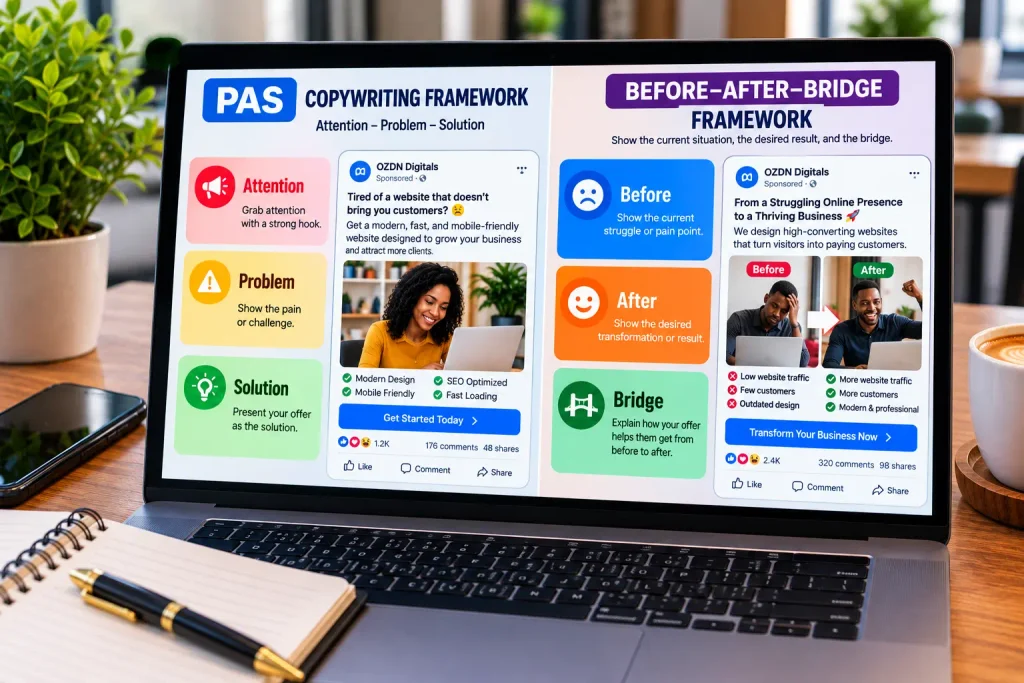
1. The PAS Formula (Problem – Agitate – Solution)
First, the PAS framework is arguably the most reliable structure for driving immediate clicks in the tech and SaaS industries. Specifically, it works because human beings are strongly motivated to eliminate daily frustrations and bottlenecks.
- Problem: Call out the exact pain point your target audience experiences right now. For example: “Still spending every Friday afternoon manually updating client spreadsheets?”
- Agitate: Highlight the hidden cost or emotional stress of leaving that problem unsolved. For instance: “One broken formula costs you hours of weekend family time and risks embarrassing reporting errors.”
- Solution: Introduce your product or service as the fast, effortless fix. Consequently, end with: “Switch to SyncFlow today and automate your client reporting in three clicks.”
2. The AIDA Formula (Attention – Interest – Desire – Action)
Second, the classic AIDA model remains a powerhouse for Facebook ad copywriting, especially when launching a brand-new product or offer. Specifically, it guides a cold prospect logically from initial awareness to a decisive click.
- Attention: Open with a bold pattern interrupt, a shocking industry statistic, or a direct question.
- Interest: Hold their focus by explaining a unique mechanism or insight they have not heard before.
- Desire: Paint a vivid picture of the transformation they will experience after using your solution.
- Action: Give a single, unmistakable instruction telling them to click the button below.
3. The Before–After–Bridge (BAB) Framework
Third, the Before–After–Bridge formula focuses heavily on positive transformation rather than dwelling on pain. Therefore, this approach works exceptionally well when writing Facebook ad copy for educational courses, productivity apps, and design tools.
First, describe the “Before” state where the reader currently struggles with a slow or frustrating process. Next, paint the “After” state where they achieve their goal quickly and confidently. Finally, position your product as the exact “Bridge” that takes them from point A to point B.
8 Actionable Tips to Master Facebook Ad Copywriting
Knowing the basic structure is only half the battle when competing in crowded social feeds. To consistently outperform your competitors, apply these eight practical Facebook ad copywriting rules to every campaign you launch.
1. Match Your Copy to Audience Awareness
First and foremost, you cannot speak to a complete stranger the same way you speak to a repeat website visitor. Therefore, successful Facebook ad copywriting always adapts to the prospect’s specific stage in the marketing funnel.
For cold audiences who have never heard of your brand, focus entirely on their problem and educate them on the solution. Conversely, for warm retargeting audiences who already visited your pricing page, use short copy that highlights customer testimonials, guarantees, or limited-time discounts.
You may also like :
Copywriting vs Copyright: The True Difference Between Copywriting and Copyright,
The Digital Marketing Funnel: Turn Strangers Into Customers
2. Lead With Benefits, Back Up With Features
In the tech world, founders and marketers love listing technical specifications, cloud architectures, and software features. However, customers do not buy features; they buy the real-world results those features produce in their lives.
Specifically, a feature is what your product has, whereas a benefit is what your customer gets. For example, instead of writing “Includes 256-bit automated cloud backup,” write “Never lose a single line of client work again, even if your laptop crashes.” Consequently, benefit-driven Facebook ad copywriting creates an instant emotional connection that drives action.
3. Use Specific Numbers and Data Points
Vague promises immediately trigger skepticism in savvy online consumers. Whenever you claim to be the “fastest,” “easiest,” or “most affordable” solution, readers instinctively tune you out.
Instead, anchor your Facebook ad copywriting with concrete numbers, percentages, and timeframes. For instance, writing “Cut your server deployment time by 43% in 14 days” is infinitely more believable than “Deploy servers faster than ever.” Furthermore, odd numbers and precise statistics naturally draw the eye as users scan through a block of text.
4. Format for Effortless Mobile Skimming
Today, the vast majority of Meta users browse their feeds exclusively on mobile smartphones. Consequently, a dense wall of unbroken sentences will cause prospects to scroll right past your advertisement.
Therefore, format your Facebook ad copywriting with plenty of white space and short, punchy lines. Limit each paragraph to one or two sentences, and use checkmark or arrow emojis as clean visual bullet points. As a result, busy readers can absorb your entire sales pitch in just three seconds.
5. Leverage Social Proof Early and Often
Nothing builds trust faster than showing that hundreds of other smart people already use and love your product. Therefore, weave social proof directly into the opening lines of your ad text.
For example, start your ad with a direct customer quote like, “This plugin paid for itself in the first 48 hours.” Alternatively, mention how many active users, five-star ratings, or industry awards your company has earned. Ultimately, strong social proof eliminates buyer anxiety before the prospect even reaches your landing page.
6. Handle Objections Before They Arise
Every prospect has silent doubts holding them back from clicking your ad. For instance, they might worry that your software is too difficult to set up, too expensive, or incompatible with their current tools.
Smart Facebook ad copywriting addresses these exact objections head-on inside the primary text or link description. Specifically, add reassuring phrases like “Sets up in 5 minutes with zero coding required” or “Cancel anytime with one click.” By removing these mental roadblocks early, you dramatically increase your click-through rate.
7. Write Conversational, One-to-One Copy
Even though your ad may reach tens of thousands of people, only one individual reads it at a time on their phone. Therefore, avoid sounding like a loud corporate announcer addressing a packed stadium.
Instead, write your Facebook ad copywriting as if you are sending a helpful message to a single colleague. Use the word “you” frequently, keep your vocabulary simple, and strip out unnecessary buzzwords. When your tone feels personal and authentic, readers naturally let their guard down and engage with your message.
8. Maintain Strict Message Match With Your Landing Page
Getting the click is pointless if the visitor immediately bounces off your website in confusion. Specifically, your ad copy and your destination landing page must feel like two halves of the exact same conversation.
Therefore, ensure the main headline on your landing page mirrors the exact promise and language used in your Facebook ad copywriting. If your ad promises a “Free 10-Point SEO Audit Checklist,” that exact title should greet the user the instant the page loads. Consequently, seamless message match boosts your conversion rate and improves your Meta ad quality score.
Common Facebook Ad Copywriting Mistakes to Avoid
Even seasoned marketers occasionally fall into habits that quietly drain their advertising budget. Watch out for these three frequent traps when creating high-converting Facebook ads.
Violating Meta’s Personal Attributes Policy
First, one of the fastest ways to get your ad rejected is calling out personal attributes directly in an accusatory or overly specific way. While you want to speak to your audience’s problems, Meta prohibits phrasing that implies you know a user’s personal health, financial status, or identity.
For example, instead of writing “Are you broke and struggling with debt?”, reframe the copy around the goal or solution: “Looking for a smarter way to manage your monthly business cash flow?” This simple adjustment keeps your Facebook ad copywriting fully compliant while still attracting the exact right buyer.
Using Clickbait That Fails to Deliver
Second, using sensational or misleading hooks might temporarily inflate your click-through rate, but it will destroy your brand trust and ad account performance. Meta tracks how quickly users bounce back to their feed after clicking an outbound link.
Therefore, make sure every bold hook in your Facebook ad copywriting ties directly to the genuine value of your offer. Honest curiosity always outperforms cheap trickery over the long run.
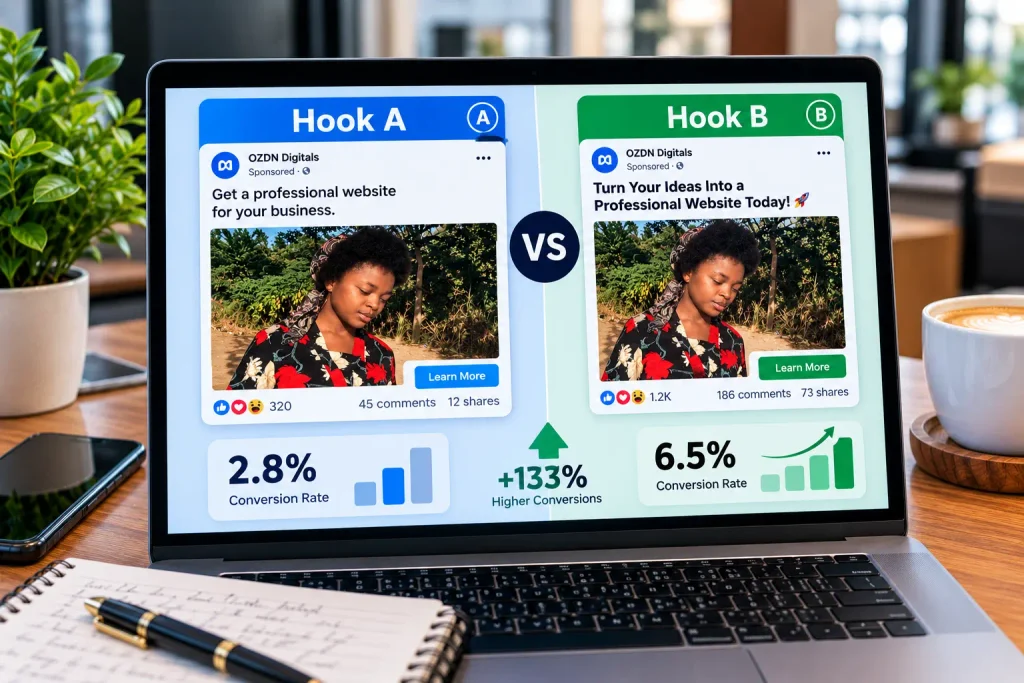
Testing Too Many Copy Variables at Once
Finally, many advertisers change their primary text, headline, image, and audience all at the same time. When the ad succeeds or fails, they have no idea which specific element caused the result.
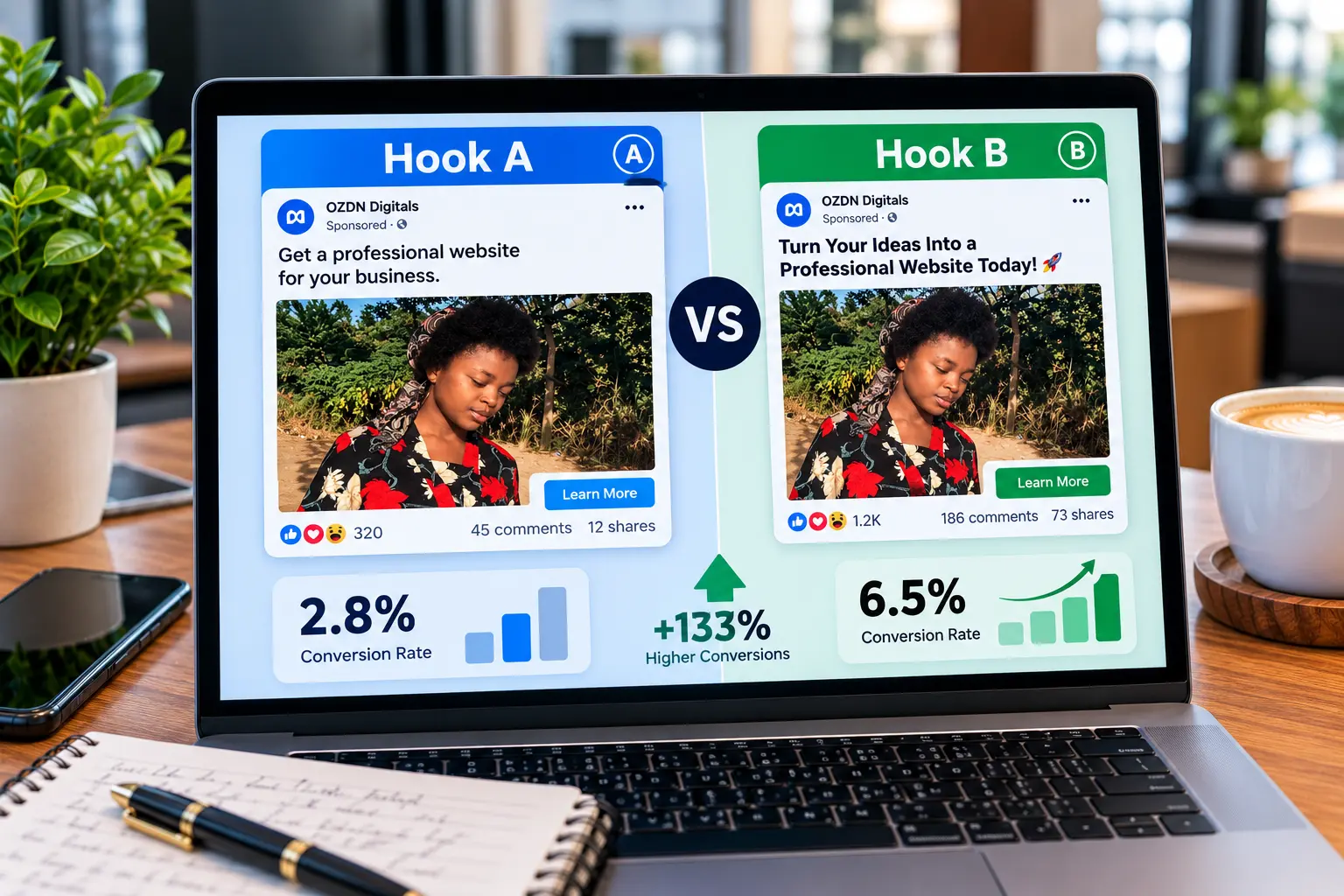
Instead, adopt a disciplined A/B testing routine for your Facebook ad copywriting. Keep your visual creative and headline identical while testing three completely different opening hooks in the primary text. Once you find a winning hook, lock it in and test two different headlines to systematically lower your cost per click.
Conclusion: Start Writing Ads That Convert Today
In summary, profitable paid advertising on Meta does not happen by accident or luck. Mastering Facebook ad copywriting requires understanding your audience’s deepest pain points, structuring your message with proven formulas like PAS or AIDA, and optimizing every text placement from the primary hook down to the headline. Furthermore, formatting your text for mobile skimmers and backing up your claims with specific numbers will immediately set your brand apart from noisy competitors.
Ultimately, the best copywriters treat every campaign as a live learning laboratory. By consistently testing new angles, eliminating friction, and focusing on real customer benefits, you can turn Facebook ad copywriting into a predictable growth engine for your business.
Ready to boost your ad performance this week? Drop a comment below sharing which copywriting formula you plan to test first, or share this guide with a fellow marketer who wants more clicks!